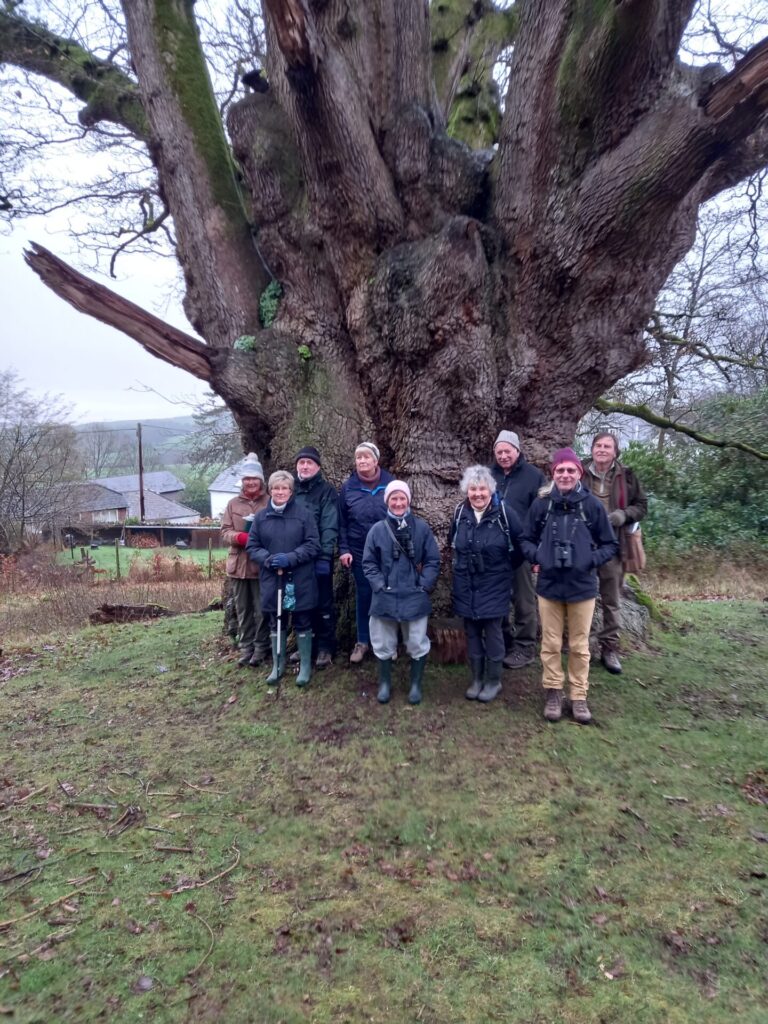
10 hardy souls walked from Holford car park to Alfoxton House on a rather cold and windy day. Paul Rutter had kindly agreed to impart some of his vast knowledge of trees and woodland and led the walk up to the house and the ancient oak tree. On the way he explained how trees grow in woodland settings and how differently they can grow in a more open setting and we were able to see this on the walk. As they age the trunk spreads and crown reduces a tactic to keep them upright. Upper branches fall off, lower branches develop from dormant buds in the trunk to reduce centre of gravity. These are some of the signs of a veteran tree. We also saw an example of a phoenix tree where a hazel had fallen but as some of its roots were in the ground it was able to grow again but with branches arising vertically from the fallen trunk.
Different trees have variable life spans so a birch could be a veteran tree at 100 years old while the oaks and yews may become veteran at a more venerable age. As trees age the bark in some trees become deeply crevassed and provides homes for many plants such as lichen and ferns and invertebrates both at larval and adult stages. The tree becomes an even more desirable destination for a birds such as woodpeckers which feed on the larvae and tree creepers which glean food from the bark. Different invertebrates find a suitable “home” at different heights of the tree, creating vertical ecological zones, some of which can be very specialised. Different sides of the tree have different ecological zones as well further increasing the species which inhabit these trees.
As a tree decays and loses branches rot holes can form creating another habitat for wildlife for example hoverflies which have aquatic larvae lay eggs in the pooled rainwater. Larger holes which enter into the heartwood will be taken by birds or bats. Even areas where water runs down the trunk provides an environment suitable to very specific and rare species of lichen.
Fungi are very important to both the establishment and growth of a tree and later in life to its gradual decay as we have seen on our fungi foray last year. Only fungi are able to break down the tough lignin making it more palatable to many invertebrates. Eventually it will break down enough to become a sawdust- like “soup” at the base of a tree and this has some of the rarest life of all as it is at such a late stage decay many trees are cut down before that stage is reached.
We had a chance to measure the girth of the tree both with Paul's extra long measure and by human means as we stretched arms put to reach round the trunk. The tape measure read 32 feet and it took 9 of us to reach round the trunk. However, it is quite difficult to estimate the age due to other factors such as the environment it has grown in and the climate it has coped with.
We were made very welcome at Alfoxton and were grateful for a hot drink and seat afterwards. Thankfully we managed to miss the rain which started about lunch time.
With grateful thanks to Paul for such a fascinating and informative walk, I certainly felt the well-being benefits of walking with trees on such a gloomy late winter day.